
Parallel performance of the YALES2(BIO) platform
YALES2BIO is a high-performance computational platform based on YALES2 , the CORIA-developed framework (Dr Moureau’s group) for combustion and spray simulations. YALES2, widely recognised for benchmarking GENCI Tier-1 machines, integrates 50+ independent solvers and supports a 600+ user community. It delivers 4th-order accuracy in space and time (3rd-order for non-homogeneous meshes) via a finite-volume approach, employing advanced numerical methods such as projection-correction schemes and a deflated preconditioned conjugate gradient solver across three mesh levels ( Moureau et al. 2011). Written in object-oriented Fortran 2008, it leverages hybrid parallelism (MPI/OpenMP) through Double Domain Decomposition, optimised with partitioning, cache-blocking, and sub-cell grouping for efficient interpolation and particle localisation. Enhanced by external libraries (PARMETIS, HDF5, FFTW3) and Git version control (private GitLab), the platform ensures robustness via 400+ nightly non-regression tests and comprehensive documentation (Sphinx documentation, Doxygen, user forums). Community engagement is fostered through Extreme CFD workshops and hackathons. In 2024, YALES2 secured 25M CPU hours on EuroHPC’s Tier-0 MareNostrum for the APOTHEOSIS project (primary atomisation studies) and was selected to benchmark the Alice Recoque Exascale computer (CEA-EuroHPC Jules Verne consortium). It achieves ~25 µs computational time per iteration for up to 100M elements on Tier-1 ADASTRA (AMD). Some comparisons with other solvers can be found in Abdelsamie et al., Comp & Fluids 2021 (see also link). See also this white paper for a comparison with the AVBP solver of CERFACS dedicated to turbulent flows with combustion. <\p>
YALES2BIO, which inherits all the capabilities of YALES2, also includes dedicated features for blood flow simulations. These include Arbitrary Lagrangian-Eulerian (ALE) methods for moving domains, Immersed Fluid-Structure (IFS) interaction for valves and red blood cell membranes, as well as specific methods for the dynamics of rigid particles such as unactivated platelets. It also integrates simplified models for biomedical mechanisms, including coagulation schemes and the unfolding of the vWF protein. Additionally, dedicated solvers address engineering challenges, such as Coulter-based counting and sizing of red blood cells and MRI-based image generation. The platform is provided free of charge to academic groups to foster collaboration and innovation within the biomechanical research community.
YALES2/YALES2BIO have been used for years on the various massively parallel platforms of GENCI. Speed-up and scale-up measurements on IBM Blue Gene/P and Curie are presented in Figures 1 to 3. Scale-up measurements are performed by increasing the mesh size, while speed-up or strong scaling measurements are conducted with a constant mesh size. These results demonstrate the good performance of the code but also highlight the difficulty of achieving linear speed-up with linear solvers applied to elliptic problems, such as those found in the incompressible Navier-Stokes equations.
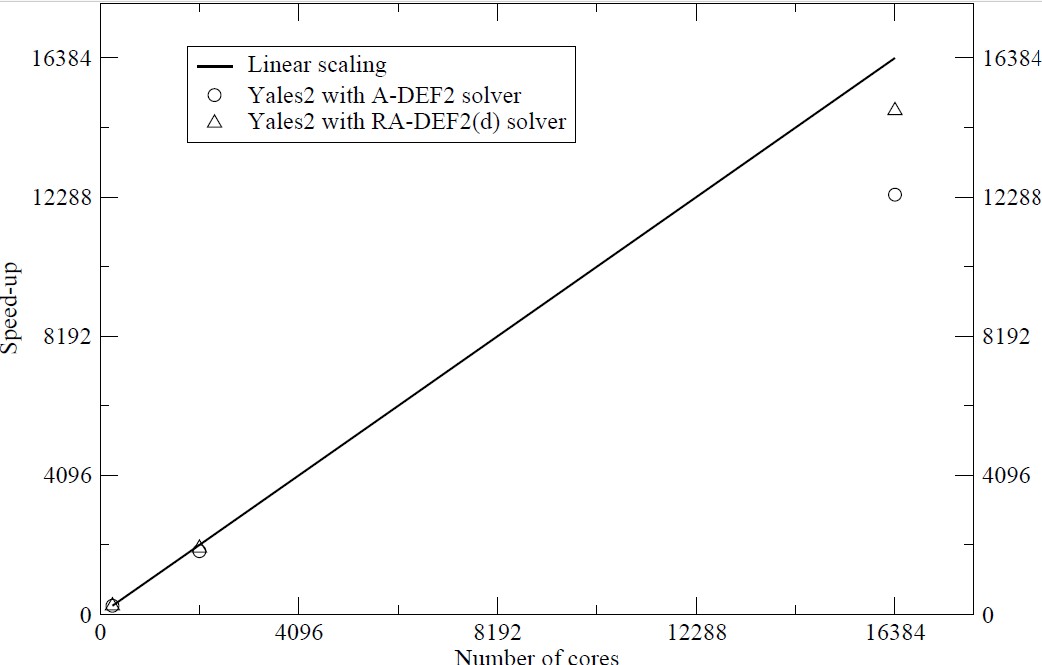
Figure 1: Scale-up on Babel for incompressible Navier-Stokes simulations (obtained by CORIA on YALES2).
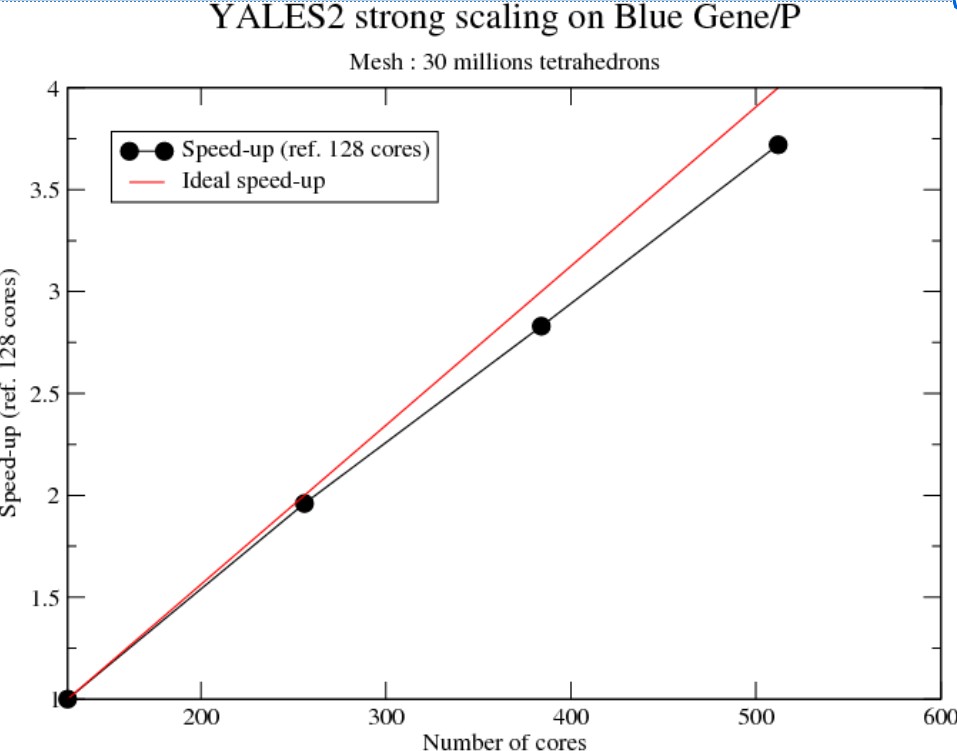
Figure 2: Speed-up on Babel for incompressible Navier-Stokes simulations (obtained by CORIA on YALES2)
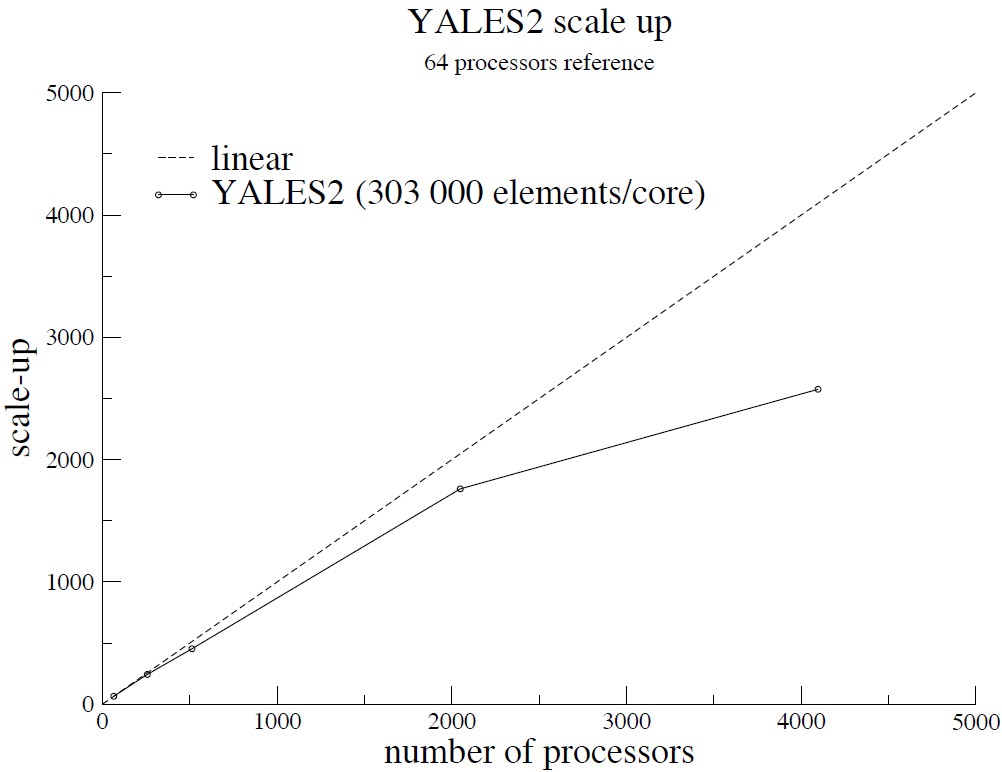
Figure 3: Scale-up on Curie for incompressible Navier-Stokes simulations (obtained by CORIA on YALES2).
Figure 4 presents the parallel performances of YALES2BIO when simulating red blood cell suspensions. The achieved speed-up is excellent and allows us to perform massively parallel computations of concentrated red blood cell suspensions.
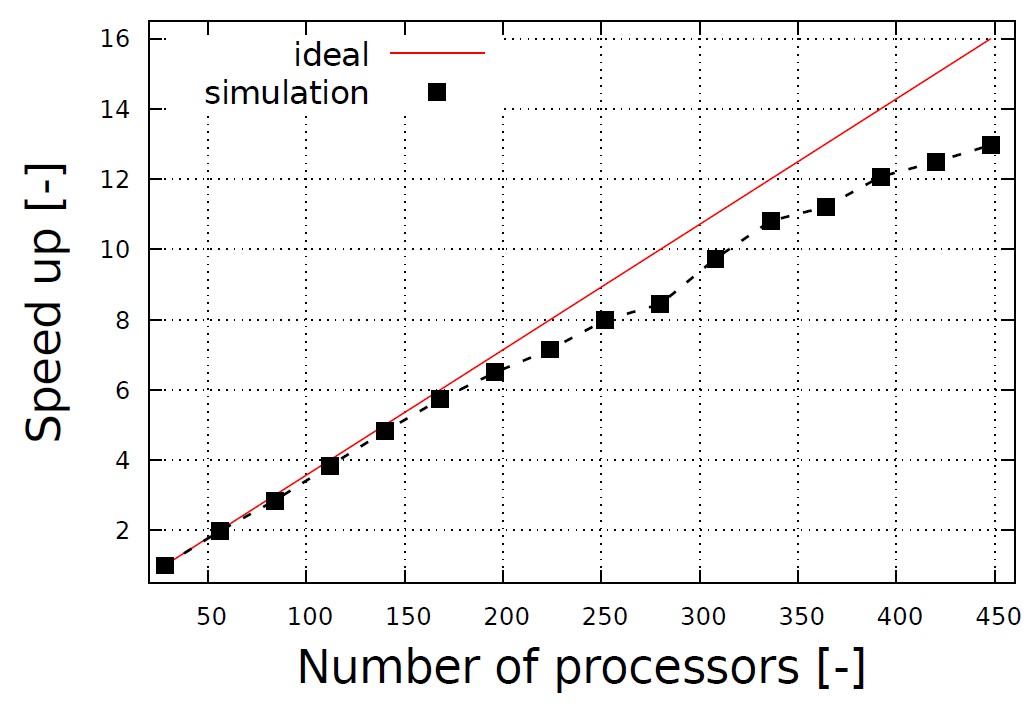
Figure 4: Speed-up on OCCIGEN for red blood cell simulations