
L’Institut Montpelliérain Alexander Grothendieck – IMAG – est une unité mixte de recherche commune au CNRS et à l’Université de Montpellier (UMR n°5149) en partenariat avec l’INRIA, localisée sur le campus Triolet de l’Université de Montpellier.
La semaine de l’IMAG
Actualités
- Workshop « Mathematical modeling for ecology and evolution » 5-6 nov. 2026
The ERC project MUSEUM and the OcciMath federation are jointly organizing a workshop at the interface of mathematics, ecology, and evolution. The workshop will take place on November 5th and 6th at the Institut Montpelliérain Alexander Grothendieck (IMAG) and will serve as a platform for exchange between mathematicians and biologists. To kickstart the discussions, there will be three sessions featuring pairs of talks, alternating between mathematics and biology.
Organization committee :
- Grégory Faye (CNRS & Univ. Toulouse)
- Matthieu Hillairet (IMAG)
- Sepideh Mirrahimi (IMT)
- Ariane Trescases (CNRS & Univ. Toulouse)
- Fête de la Science 2026

A l’occasion de la Fête de la Science 2026, l’IMAG le DEM et L’IRES se mobilisent du samedi 3 au lundi 5 octobre 2026 sur la place du Village des Sciences à la faculté d’éducation, les expositions « Pourquoi les mathématiques ? » et « Paysage mathématique » y seront présentées.
L’exposition Pourquoi les mathématiques ? très interactive, montre aux visiteurs que les mathématiques sont intéressantes, étonnantes, utiles, accessibles à tous, très présentes dans la vie quotidienne, qu’elles débouchent sur de nombreux métiers, et qu’elles jouent un rôle primordial dans la culture, le développement et le progrès. Cette exposition constituée de nombreux objets à manipuler sera présentée par des chercheurs, des chercheuses et Doctorants en mathématique.
Paysage mathématique est une illustration qui éclaire la diversité des mathématiques, et leurs liens avec notre environnement. L’esthétique enfantine de l’image, similaire à un jeu de cherche et trouve, est un choix délibéré pour attirer l’attention d’un large public et permettre une échange autour des mathématiques.
Retrouvez le programme complet du Village des Sciences de Montpellier ici.
- Prof. Daniel Castañón Quiroz is invited to IMAG from 25 September to 10 October 2026 as part of the ERC NEMESIS project

Daniel Castañón Quiroz is currently an assistant professor at the National Autonomous University of Mexico (UNAM) in Mexico City. He obtained his Ph.D. in mathematics at the university of Texas A&M in United States. After that he was a postdoctoral fellow at the university of Montpellier (at IMAG), and then a postdoctoral fellow at the university of Côte d’Azur (at LJAD). He main research interest is numerical analysis using finite elements for solving applications related to fluid flow problems.
- Prof. Lorenzo Mascotto is invited to IMAG from 20 to 24 September 2026 as part of the ERC NEMESIS project
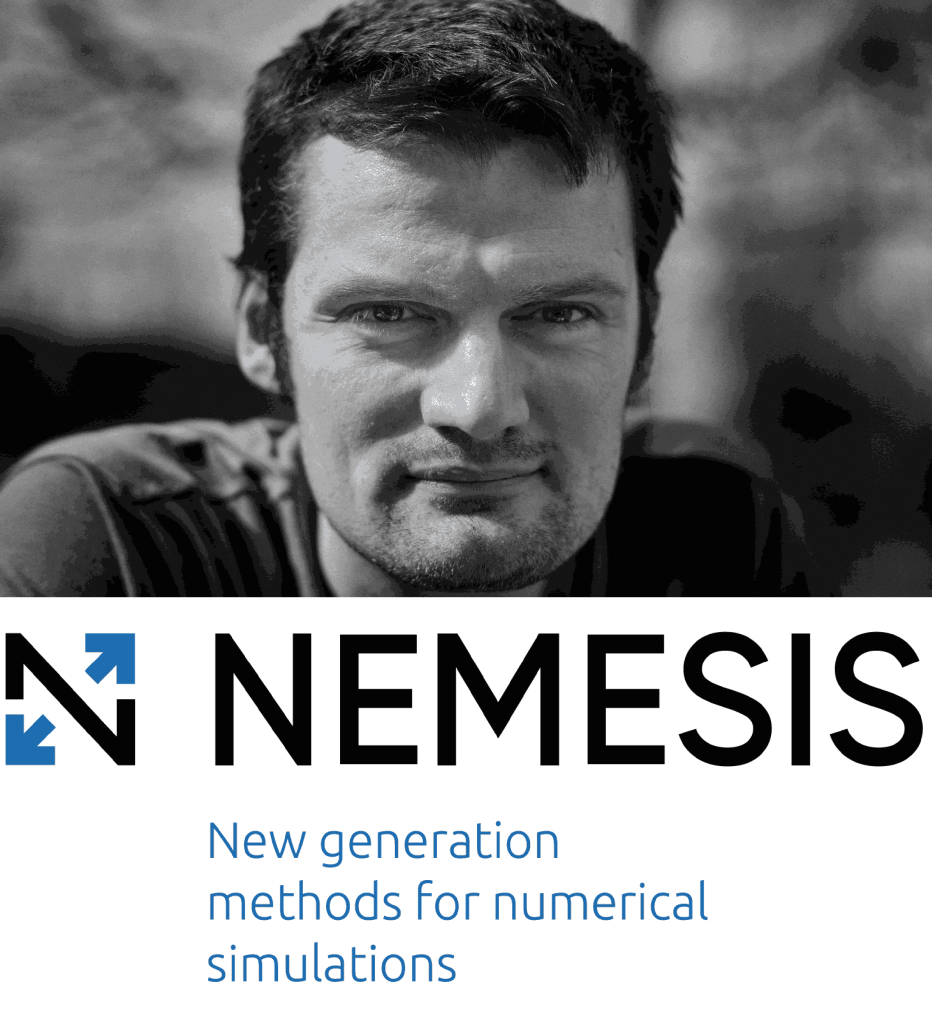
Lorenzo Mascotto is an Associate Professor of Numerical Analysis at the University of Milano-Bicocca (lecturer 2021–2024). He earned a joint Ph.D. in 2017 (Milan and Oldenburg) and held a postdoctoral position at the University of Vienna (2017–2021). His research focuses on nonstandard PDE discretizations, particularly high-order and adaptive nonconforming methods, including virtual element, discontinuous Galerkin, and Crouzeix–Raviart methods. His work also covers functional inequalities on general polytopic meshes, including Sobolev–Poincaré, trace, and Nečas–Lions estimates on broken Sobolev spaces. He serves on the editorial board of Calcolo and co-organizes the 2027 Hausdorff Trimester Program « Nonstandard Discretizations of Partial Differential Equations: from Theory to Applications » in Bonn.
He will give a talk on 21st September 2026 with title « Equivalences and geometric bounds for W¹,ᵖ inf-sup constants ». In this talk exact identities are established, which relate the inf-sup constant β in the W¹,ᵖ Banach setting to the optimal constants in the Nečas–Lions and Babuška–Aziz inequalities, as well as the minimal eigenvalues of nonlinear Cosserat operators. Based on these equivalences, lower bounds for β are derived that are fully explicit with respect to geometric parameters for structured domain classes, such as star-shaped domains or domains admitting regular tessellations.
- Le projet MSCA EffECT s’achève après deux années de recherche à l’IMAG
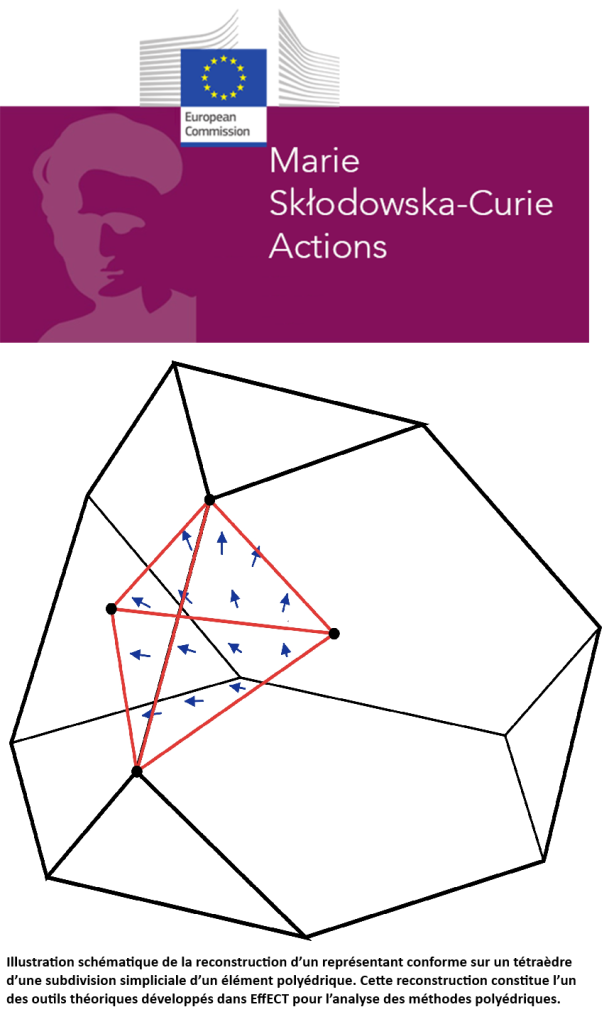
Le projet EffECT, financé par une bourse postdoctorale Marie Skłodowska-Curie et mené par Silvano Pitassi à l’IMAG sous la supervision de Daniele Di Pietro, s’est achevé fin août 2026 après deux années de recherche.
Conçu à l’origine pour développer des méthodes numériques polyédriques pour des problèmes électromagnétiques, EffECT a fait émerger un axe théorique plus général. Celui-ci est consacré aux outils fonctionnels et topologiques pour l’analyse de méthodes numériques préservant les structures différentielles et topologiques des problèmes continus.
Ce nouvel axe a donné lieu à cinq prépublications en libre accès. Les travaux ont porté sur les inégalités de Poincaré uniformes pour les complexes discrets de de Rham [1], la construction et la classification de générateurs topologiques sur des surfaces maillées [2], la construction de représentants conformes à partir de données discrètes sur des maillages polyédriques (voir l’illustration) [3], ainsi que sur la construction d’opérateurs d’extension de Sobolev compatibles avec la structure différentielle, sur des domaines de topologie générale [4].
Dans un cinquième travail, Silvano Pitassi introduit un nouveau cadre théorique Hybrid High-Order (HHO) pour les formes différentielles sur des maillages polyédriques généraux. Ce travail établit également des inégalités de Poincaré uniformes [5].
En parallèle, le volet applicatif engagé pendant EffECT se poursuit dans un travail en cours de finalisation avec Raman Kumar et Aurelio Spadotto, postdoctorants de l’équipe NEMESIS à l’IMAG. Il développe une nouvelle méthode d’ordre élevé pour les courants de Foucault sur des maillages polyédriques, en s’appuyant sur plusieurs outils développés au cours du projet.Les résultats du projet et les publications associées sont disponibles sur le site EffECT :
https://silvano-pitassi.github.io/EffECTRéférences :
[1] D. A. Di Pietro, J. Droniou, M.-L. Hanot, S. Pitassi,
Uniform Poincaré inequalities for the discrete de Rham complex of differential forms
https://arxiv.org/abs/2501.16116[2] S. Pitassi,
Generators of H¹(Γ, ∂Γᶜ) with ∂Γᶜ ⊂ ∂Γ for Triangulated Surfaces Γ: Construction and Classification of Global Loops
https://arxiv.org/abs/2504.05124[3] D. A. Di Pietro, J. Droniou, S. Pitassi,
Conforming lifting and adjoint consistency for the Discrete de Rham complex of differential forms
https://arxiv.org/abs/2509.21449[4] E. Nilsson, S. Pitassi,
Uniformly Bounded Cochain Extensions and Uniform Poincaré Inequalities
https://arxiv.org/abs/2604.04927[5] S. Pitassi,
Uniform discrete Poincaré inequalities for Hybrid High-Order differential forms on polyhedral meshes
https://arxiv.org/abs/2608.10713

Derniers dépôts dans HAL
- Daniele Di Pietro, Jérôme Droniou, Vito Patierno, A Reynolds- and Hartmann-semirobust hybrid method for magnetohydrodynamics, hal-05765164
- Charlotte Tibi, Ilyass Moummad, Alexis Joly, Yves Caraglio, Christophe Jenny, Pierre Bonnet, Hervé Goëau, On the role of geometric representations for ultra-fine-grained crop variety identification, hal-05736639
- Bijan Mohammadi, From Answers to Questions: Generative AI, Scientific Modeling, and the Future of Learning, hal-05793535
- Jérôme Droniou, Raman Kumar, Roland Masson, An Arbitrary-Order Augmented Lagrangian Discrete De Rham Scheme for Contact Mechanics with Tresca Friction, hal-05836504
- Gabriela Moraes Botaro, Tom Gimat, Hammoud Amina, Ibrahim Al Ayoubi, Jean-François Baget, Pierre Bisquert, Michel Leclère, Fabio Porto, Federico Ulliana, Patrick Valduriez, Showcasing the Gypscie AI Artifact Management Platform, hal-05778906
Contact
imag-direction@umontpellier.fr
IMAG – UMR 5149
Université de Montpellier
Case courrier 051
Place Eugène Bataillon
34090 Montpellier – France
Tel. +33 (0)4 67 14 31 57
Venir à l’IMAG


